


Introduction
You have spent months dialing in your vision. The floor plan is locked. You know where the glass walls will face the Red Rock mountains. You have selected the stone for the facade, chosen the wood ceiling finish, and mapped out the kitchen layout down to the last pull-out drawer.
Then the question comes up: what about smart home technology?
Suddenly the scope feels enormous. Do you need it? When do you add it? How much does it actually cost? Here is the truth most homeowners in Las Vegas don’t discover until it is too late. A smart home is not something you bolt on after the drywall goes up. It is something you engineer before the first wall is ever framed. The difference between a seamlessly integrated home and a frustrating tangle of afterthought gadgets comes down entirely to timing.
At Luker Construction, we treat technology as a structural element, not an add-on. Our design-build process builds the infrastructure for your smart home during the earliest stages of the project, ensuring your home doesn’t just look like the future. It functions like it.
Curious what this looks like in practice? Call 702-805-0240 or visit lukerconstruct.com/contact-us/ to schedule your Discovery Call.
Key Takeaways
- Smart home systems must be planned during design, not after construction, or you pay a significant retrofit premium
- Las Vegas custom homes benefit from specific automation: multi-zone HVAC, motorized shading, solar monitoring, and whole-home audio
- Retrofitting technology into a finished luxury home often requires opening walls, cutting ceilings, and bringing back multiple trades at substantial additional cost
- Luker Construction integrates technology infrastructure planning into the preconstruction phase of its 7-step process, so your home is wired for the future before the first board goes up
Why Timing Is Everything in Smart Home Planning
Most homeowners who end up with a disconnected, app-heavy smart home did not plan it that way. They planned to add technology after the build and discovered too late what that decision actually costs.
To run new control wiring through finished walls, you cut them open. To route speaker cables through ceilings, you pull drywall. To add a dedicated circuit for an AV equipment rack, you bring an electrician back for a second visit at finished-space rates. Each fix costs far more than it would have during rough-in, and none of it ever looks quite as clean as infrastructure planned from the beginning.
There is also the coordination problem. Without a unified platform, homeowners end up managing five separate apps for five separate systems. One for lights. One for the thermostat. One for security cameras. One for the pool. Another for outdoor speakers. None of them communicate with each other. None respond to a single command.
The promise of the smart home never materializes. You have devices in the home. You don’t have a smart home.
Building Intelligence Into the Blueprint
Luker Construction approaches technology the same way we approach every other element of your build. We plan it before the walls close.
Long before we pour a foundation, we are asking the right questions. What systems matter most to you? How automated do you want your day-to-day experience? Do you want a home that responds to scenes, a morning command that opens the shades, adjusts the temperature, and starts the coffee simultaneously? Do you entertain often and need whole-home audio that follows guests from the kitchen to the pool deck without a gap?
The answers define the infrastructure. And the infrastructure defines everything.
Here is the Luker standard for smart home integration:
Single-Platform Architecture. We help clients select a unified control platform, such as Lutron, Control4, or Crestron, that brings all systems under one interface. Lighting, shading, HVAC zones, security, audio, and video. One app. One panel. Total control.
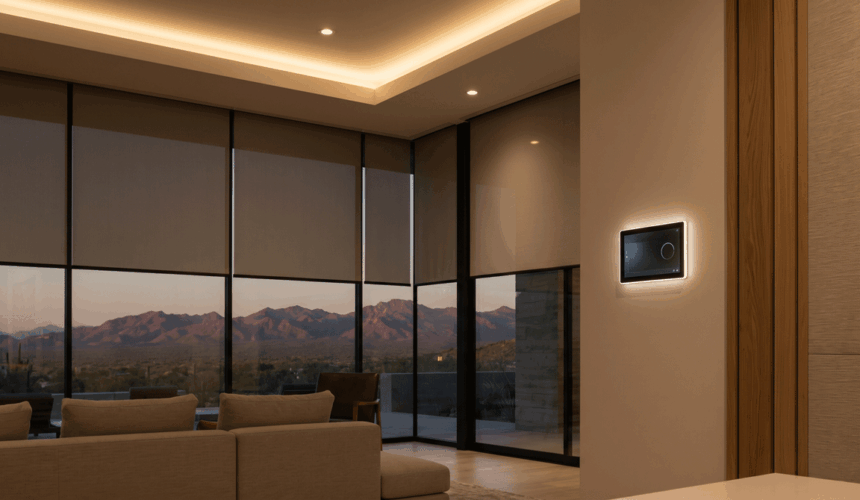
Desert-Specific Engineering. Las Vegas is one of the most demanding climates in the country for both home systems and electronics. We integrate multi-zone climate control, motorized low-E shading that responds to sun position automatically, and solar production monitoring from day one. In a city where cooling costs dominate the summer budget, these systems deliver genuine returns.
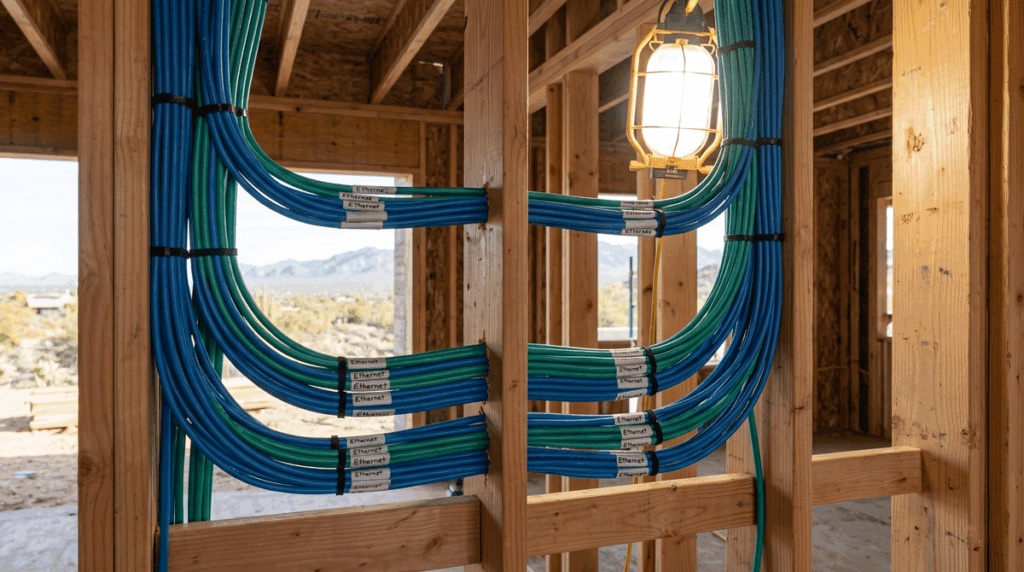
Future-Proof Wiring. During rough-in, we run conduit and home-run ethernet to every room, every AV location, and every anticipated tech hub. When new technology emerges two years from now, your home is already ready. You plug in, not cut in.
How Technology Gets Built Into Every Stage of Your Project
Our 7-step process gives smart home planning a defined role at every phase of the build, so nothing falls through the cracks between design and construction.
Step 1: Discovery Call
During the initial Discovery Call, we introduce the technology conversation before design begins. We ask about your lifestyle patterns. Do you travel frequently and need remote monitoring? Do you want your home to detect your arrival and respond before you reach the front door? This conversation happens early so that what you want is actually achievable in the home we build.
Step 2: On-Site Consultation and Vision Session
For clients purchasing a lot, we walk the property with solar orientation and technology infrastructure in mind alongside architectural considerations. We identify where the equipment room should sit within the home’s layout and how the AV zones map against the floor plan. These decisions made now save significant cost and compromise later.
Step 3: Design and Preconstruction Planning
Once system requirements are defined, we build the technology infrastructure into the architectural drawings and preconstruction planning. Conduit routes, panel sizing, dedicated circuits, and equipment room layout all get resolved during this phase. Your architect draws the aesthetics. We protect the function. This is where the retrofit premium gets eliminated entirely. Everything is built into the BuilderTrend portal so your full project scope is visible and accurate from day one.
Step 4: Proposal and Contract
Your technology infrastructure is a defined line item in your proposal, not a vague allowance. Every conduit run, every data drop, every dedicated circuit is scoped clearly. You approve the full picture before any work begins.
Step 5: Build Phase
During construction, our team installs the technology infrastructure in the correct sequence with the build. Conduit goes in before walls close. Speaker locations are confirmed before drywall. The equipment room is built to spec alongside the mechanical room. Your project manager coordinates directly with your technology contractor through BuilderTrend so every trade is sequenced correctly and nothing waits on a miscommunication.
Step 6: Quality Assurance and Final Walkthrough
In the final phase, we verify every technology infrastructure element before systems are commissioned. Every conduit is tested. Every data drop is confirmed. Nothing is left for the technology contractor to discover after the walls are closed.
Step 7: Programming, Commissioning, and Warranty
Your systems get programmed and handed off properly. We walk you through every scene, every control, and every feature until using your home feels completely natural. Warranty documentation covers the construction elements of your smart home infrastructure, and we remain available for any follow-up support you need.
A Home That Thinks for You
Picture this. You pull up to your house after a long day in Henderson. Your phone detects you are two minutes out and triggers the arrival scene. The gate opens. The exterior lighting rises to a warm welcome level. The front door unlocks. By the time you step inside, the living room is set to your preferred evening setting, the temperature is exactly where you want it, and the speakers are playing the playlist you had on this morning.
You didn’t press a single button.
On a July afternoon poolside, the sun shifts to a sharp angle and the exterior shading panels lower automatically, cutting the glare without touching your view of the mountains. You adjust the pool temperature from your phone. The outdoor speakers shift seamlessly as you walk back inside through the glass wall. Everything works together because everything was planned together.
This is the standard our clients in The Ridges and MacDonald Highlands experience in their Luker-built homes. Michael R. from The Ridges described his build as “a great experience from concept to completion,” and that experience extends to every system you interact with thirty times a day. Tiffany S. from Southern Highlands called us “transparent, organized, and easy to work with,” and that transparency runs through every technology decision we make on your behalf.
Explore our completed custom home projects at lukerconstruct.com/projects/.
Your Next Step
Smart home infrastructure is one of the only elements of a custom build that becomes exponentially more expensive to add after construction. Once the walls close, the opportunity closes with them.
If you are planning a custom home in Las Vegas, Henderson, or the surrounding communities, the technology conversation needs to happen now, before the design is finalized.
Schedule your Custom Home Discovery Call with Luker Construction at 702-805-0240 or email info@lukerconstruct.com. Let’s build a home that works as intelligently as it looks.
Frequently Asked Questions
How much does smart home integration add to a custom home budget in Las Vegas?
A foundational package covering lighting control, motorized shading, and a unified thermostat can represent roughly one to two percent of your total build budget. A comprehensive whole-home platform from Control4 or Crestron with multi-room audio and full automation typically falls in the three to five percent range. Either way, planning it from the start means you are paying only for the system itself, not for retrofit labor or reopened walls.
What smart home platform does Luker Construction recommend for Las Vegas luxury builds?
We work frequently with Lutron for lighting and shading control, which is the industry benchmark for precision and reliability. For whole-home automation, Control4 and Crestron are both exceptional platforms with strong local support in the Las Vegas metro area. The right choice depends on your lifestyle and how hands-on you want the daily experience to be. We help you navigate that decision during the Discovery Call.
Can I add smart home features after my home is finished?
You can, but the cost is significantly higher and the results are rarely as refined as a planned installation. Wireless retrofit systems offer more flexibility than running new wire, but they still do not match the performance of a properly wired infrastructure. The most cost-effective decision is always to plan it before the walls close.
Will electronics hold up in Las Vegas summer heat?
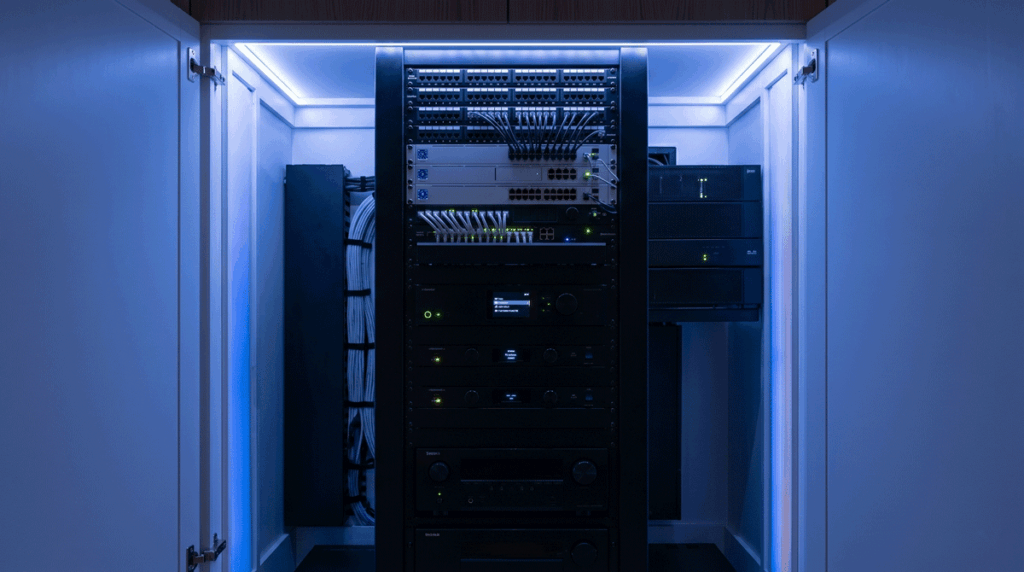
Yes, with the right approach. The key is designing a dedicated, climate-controlled equipment room during the build, which we always plan into our smart home projects. Keeping your central hub, amplifiers, and network gear in a cooled enclosure extends system life dramatically and prevents the overheating issues that come from poorly planned installations.
Does Luker Construction work with third-party technology contractors?
Yes. We coordinate directly with your preferred technology integrator during the build. If you already have a relationship with an AV company or home automation specialist, we bring them into the planning process during preconstruction so that the infrastructure we build matches exactly what they need. Coordination through BuilderTrend keeps every trade on the same schedule.
About the Author
The Luker Construction Editorial Team
We are a team of luxury home builders based in Las Vegas, Nevada, passionate about the intersection of architecture and technology. Luker Construction specializes in custom home construction, full-home renovations, Signature Kitchen Packages, and commercial tenant improvements throughout Clark County. Licensed and insured, we are headquartered at 330 E Warm Springs Rd Suite 136, Las Vegas, NV 89119. Our team has spent years mastering the specific demands of building high-performance custom homes in the Mojave Desert, from engineering glass walls that handle triple-digit summer heat to designing electrical systems ready for the next generation of home automation. We serve the Las Vegas Valley’s most prestigious communities, including The Ridges, MacDonald Highlands, and Ascaya. Reach us at 702-805-0240 or info@lukerconstruct.com to schedule your Discovery Call
